What is Freedom of Association?
“In the workplace, the right to freedom of association is a right which entitles workers to form and join workers’ organisations of their own choice in order to promote common organisational interests”.
Why is it important?
Workers’ rights and employment practices are regulated by s 18 and s23 of the Constitution and labour laws promulgated to ensure the protection of constitutional provisions contained in the Bill of Rights.
Freedom of association is crucial for the realisation of provisions contained in labour law as it gives workers the right to organise and to join trade unions which represent workers to negotiate improved working conditions, resolve labour disputes and enter into collective bargaining agreements. Labour laws also protect those who choose not to form part of any associations or groups.
The right to the freedom of association is also important because it underpins the founding principles of a free and open democratic society, which are contained in the Constitution’s founding provisions. It also conforms to standards set by international human rights law on the humane treatment of workers in their respective workplace environments. International organisations such as the International Labour Organisation (ILO) recognise the importance of the freedom of association and are involved in creating global standards that help to ensure ethical trade at the international level.
What does South African law say?
S18 of the Constitution guarantees that: “Everyone has the right to freedom of association”. Section 23 of the constitution outlines specific rights of workers and employers to form unions and associations and to engage in collective bargaining as regulated by national legislation.
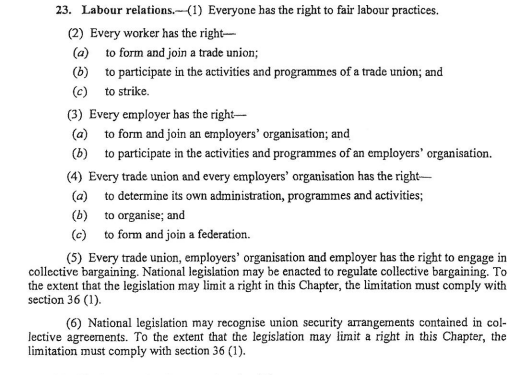
The Labour Relations Act (LRA) seeks to enact these constitutional provisions to specifically address what are considered to be fair and unfair labour practices.
Building on these provisions, the Basic Conditions of Employment Amendment Act, further elaborates the rights and duties of employees and employers, and sets out procedures regulating leave, working hours, remuneration, dismissals etc.
These legislative provisions however, all stem from s18 and s23 of the constitution.
How do the ethical trade and sectoral codes try to promote FOA?
A series of sector codes have also been developed to better facilitate, ensure and audit agreed standards regulating ethical trade practices within the agricultural sector. These also address the rights of workers to freedom of association. The table below compares how the different codes place duties on employers to provide workers with information on their rights to freedom of association.
Ethical Trade Initiative(ETI)
|
Wine and Agricultural Ethical Trade Association (WIETA)
|
Sustainability Initiative of South Africa (SIZA)
|
Information regarding the rights of workers and their rights freedom of association must be displayed in the workplace noticeboard.
The information must be translated in the appropriate languages.
| Information must be displayed in workplace.
a) display rights-related information; The code requires workplaces with unionised workers (where shop-stewards have been elected in accordance with the LRA) to: b) display shop steward contact details in a location easily accessible by workers.
| Information must be displayed in workplace.
Employers must submit evidence of the placement of such information on notice boards in a region accessible to workers.
Employers are required to provide attendance registers and workshop content, where workers attended a training session on their right to freedom of association.
|
FOA in practice
So if the constitution, legislation and private codes provide various avenues for promoting workers’ rights to the freedom of association we have to ask why this right has yet to be realised for so many workers in the agricultural sector?
What makes freedom of association difficult to achieve?
If workers are to practically exercise their right to freedom of association they need to be able to meet together and with representatives of worker unions. The difficulty in this regard is that a significant proportion of the permanent agricultural labour force live on farms and are best accessed through their workplaces – both of which are on property owned by their employers.
Industry perspectives
Organisations representing employers in the agricultural sector raise concerns which often make them unwilling to practically promote FOA.
Security concerns
The rights of property owners are constitutionally protected in Section 25 of the constitution. This enables employers to limit access to their property if they deem that this poses a security threat to their person or property. Ultimately, this results in a clash between the rights of the workers to freedom of association and the rights of the employer in relation to their property.
In 2001 in a context of concerns about mounting crime and violence on farms, AgriSA negotiated a farm access protocol which severely restricted outsider access to farms. With regard to FOA the protocol limits worker organisers to meeting workers off farms permitting direct farm access only in “highly exceptional circumstances”.
Concerns that unions will disrupt production
Where workers’ unions and employers are unable to agree on wages and working conditions unions may direct their members to ‘down tools’ and engage in strike action to bring pressure on the employer to settle the dispute. While workers have the right to strike and peacefully protest, this has costly consequences for employers when they do – particularly when workplace disputes are declared at critical points on the agricultural calendar such as planting or harvest times.
As a result many employers have encouraged the formation of farm based worker committees to provide a forum for employer and worker interaction. Employers may argue that these committees are more effective than trade unions which they regard as having failed to adequately organise and represent workers and which require that workers pay membership fees.
In combination these factors make many employers reluctant to promote FOA which in turn makes it difficult for union representatives to meet with and organise workers on farms.
Union perspectives
Trade unions highlight the challenges of organising in the agricultural sector. Key constraints include::
Lack of access to farms makes it difficult for unions to achieve sufficient representation to negotiate on behalf of workers
Employers are required by law to grant organisational rights to unions which reflect the level of union representation in the workplace. This can vary from ‘sufficient representation’ where union membership constitutes less than 50% of the total number of employees, or where unions are recognised based on their representing the majority of the workforce. However both sufficient and majority representation remain difficult for union organisers to achieve as:
- Employers restrict access to farms citing the provisions of the farm access protocol.
- Many farms are remote and union organisers lack resources to travel.
- Lack of union information on the sector codes/ skepticism about their value
- Many union organisers state that they lack information about how the industry codes can practically promote and advance FOA for farm workers.
- Others remain skeptical about the value of the codes as a mechanism to advance worker rights and interests.
Lack of resources to access farm data
Bodies seeking to promote ethical and environmentally sustainable trade through audited standards collect information on the agricultural enterprises which make up their membership. This includes data on workers employed on the farm. Union organisers report that they are required to pay a fee to register on these platforms and gain access to this data - a cost which some unions find difficult to meet.
Contestation between registered and unregistered unions
Section 96(1) of the LRA requires that trade unions must be registered. Unions seeking registration with the Department of Labour are required to provide details of office bearers and union employees, the number of paid up members in each industry or sector and the contact information for the union. While the LRA does not prescribe any membership threshold which unions need to meet in order to register, guidelines issued in terms of the Act indicate that an extremely small membership may indicate that the organisation is not a genuine union.
Some organisers for registered trade unions indicate that their efforts to recruit workers can be thwarted by fraudulent and unregistered organisations posing as unions to collect membership fees from workers. They indicate that these bogus unions have amplified worker distrust of unions in general.
Worker perspectives
Some workers fear that they may be victimized for affiliation or association with trade unions which could threaten their livelihood. Some workers report negative experiences of being exploited by fraudulent unions operating in the sector. This has created an issue of mistrust of those who claim to be union representatives, when unions seek to recruit members and represent their concerns in disputes regarding their employment. Continuing union competition within the agricultural sector makes it difficult for workers to decide which union would be best suited to represent them and their rights.
What needs to change?
If FOA and collective bargaining are to become a reality in the agricultural sector:
- Legal provisions to promote freedom of association need to be better enforced and monitored
- Greater consistency should be achieved across sector specific codes:
- The way in which sector-specific codes are drafted can create disproportionate protections for workers across the agricultural sector. Different codes have varied levels of strictness and compliance. Some codes impose more responsibility on employers to communicate information about freedom of association to workers.
- This effectively means that there is a lack of uniformity across the agricultural sectors in relation to which workers are better informed and assisted in the realisation of their right to the Freedom of Association.
- More emphasis be placed on worker education on socio-economic and labour rights
- Many farmworkers have had inadequate access to basic education, which can make the display of information as required by the codes difficult for these workers to comprehend.
- Codes need to make practical provisions for workers to obtain accessible information about the intricacies of the code and how freedom of association can be practically realised on the practical level is paramount. If there are no unions present and effective on farms, responsibility for providing this information rests solely on the employer, and in their workplace.
Negotiating a union access protocol as part of the sector codes
Sections contained in the LRA grant unions the right to access the work premises of employees for union-related purposes. This, however, is conditional on the basis of a variety of factors (union registration, etc.) and is subject to being facilitated through a mutually agreed process between employers and representatives.
Currently employers continue to deny union access to farms citing security concerns and the conditions of the Farm Access Protocol to restrict access. This suggests that within particular sector codes, or as part of value chain roundtables there is potential for developing mutually agreed processes which will facilitate union access to farms and promote the right of freedom of association.
