Wednesday, 7 February 2018

Impacts of the drought on employment in Western Cape - 50 000 out of work soon?

In a recent article in Business Day Agri-Western Cape CEO Carl Opperman is quoted as stating that Western Cape farmers have recorded 14 billion in losses as a result of  back to back droughts. The article forecasts that "an estimated 50 000 people could be out of work soon". According to Opperman the employment losses would primarily be experienced  by seasonal workers who would  either be employed for fewer months, or who might not find work at all.

The drought has forced officials to impose strict water restrictions, and the agricultural sector, which is the largest consumer of water, has had its supply curtailed by between 60% and 87%, Opperman said:"Both the fruit and vegetable industries have been hard hit by the drought and water restrictions. In the Ceres area, for example, the limited water supply resulted in 50% less onions and 80% less potatoes being planted this season. This impacts on food production and wage losses of millions of rand for seasonal workers."

Photo: Ashraf Hendricks: Ground Up

Similar concerns were also reported in October 2017 by provincial CoGTA which highlighted the risk of "civil unrest" as an estimated R40 million rand in agricultural workers wages had been lost as farmers cut back on new planting and harvests fell. 

How will the drought impact on advancing a joint programme for decent work in the agricultural sector?  

Potentially the imapcts are enormous as producers and workers experience hard times. Putting such a programme in place requires that producers, workers organisations, state and civil society organisations remain in productive conversation to improve conditions on farms. The drought and projected layoffs risk placing these relationships under intense strain and raise the level of conflict risk in the sector.

Can the drought present an opportunity?

Despite the risks identified above these diificult times can also be regarded as an opportunity to intensify and deepen  multilateral conversations. Not everyone has subscribed to doomsday scenarios. Patrick Dowling highlights that:
"Realising that world‚ national and local leaders can do only so much‚ people have started working co-operatively and innovatively. There are domestic‚ street and faith-based responses‚ workplace plans and initiatives to support frail and vulnerable. As people work together‚ mesh talents and develop trust more dots are joined‚ giving issues of sustainability and co-operative solutions new meaning and practical application".


These initiatives need to integrated into the agricultural landscape. There are are many things this protracted drought can teach us. It will be important for producer bodies and the provincial department of agriculture to communicate clear and reliable information about the impacts of the drought and to project how these impacts could play out for different commodities and in particular localities.

A wide range of actors need this information so that joint responses can be developed,  solutions found, implemented and monitored. Hard times should provide the cue to open up spaces for dialogue and communciation rather than closing them down.

Monday, 8 January 2018

Freedom of Association: From theory to practice


This is an edited version of a longer article researched and written by Anela Feleza- while working as an intern at Phuhlisani NPC. The article draws on the record of discussion from a series of workshops run as part of the Decent Work in Agriculture (DWiA) programme to explore the ways in which freedom of association and collective bargaining can be advanced by sectoral codes regulating good practice in the agricultural sector.

Introduction

Following South Africa’s democratic transition in 1994 new laws and state-institutions were developed in a bid to reverse our deeply ingrained history of racial discrimination and worker exploitation. Up until the early 1990’s workers on farms remained unprotected by any form of labour law. Employment contracts were governed by common law which also allowed employers to retrench and evict workers at will. While new laws and private sector producer codes have sought to protect vulnerable workers from exploitation and ensure decent work in the agricultural sector, there remain concerns about the extent to which these protections have been implemented to improve the living and working conditions of farm workers and dwellers. While freedom of association is constitutionally guaranteed many constraints remain which limit trade union access to workers on farms and the restrict potential for collective bargaining in the sector.

FOA in theory 

What is Freedom of Association?

“In the workplace, the right to freedom of association is a right which entitles workers to form and join workers’ organisations of their own choice in order to promote common organisational interests”.

Why is it important?

Workers’ rights and employment practices are regulated by s 18 and s23 of the Constitution and labour laws promulgated to ensure the protection of constitutional provisions contained in the Bill of Rights.

Freedom of association is crucial for the realisation of provisions contained in labour law as it gives workers the right to organise and to join trade unions which represent workers to negotiate improved working conditions, resolve labour disputes and enter into collective bargaining agreements. Labour laws also protect those who choose not to form part of any associations or groups.

The right to the freedom of association is also important because it underpins the founding principles of a free and open democratic society, which are contained in the Constitution’s founding provisions. It also conforms to standards set by international human rights law on the humane treatment of workers in their respective workplace environments. International organisations such as the International Labour Organisation (ILO) recognise the importance of the freedom of association and are involved in creating global standards that help to ensure ethical trade at the international level.

What does South African law say?

S18 of the Constitution guarantees that: “Everyone has the right to freedom of association”. Section 23 of the constitution outlines specific rights of workers and employers to form unions and associations and to engage in collective bargaining as regulated by national legislation.
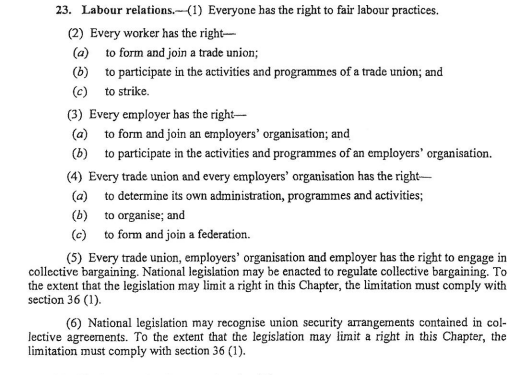


The Labour Relations Act (LRA) seeks to enact these constitutional provisions to specifically address what are considered to be fair and unfair labour practices.

Building on these provisions, the Basic Conditions of Employment Amendment Act, further elaborates the rights and duties of employees and employers, and sets out procedures regulating leave, working hours, remuneration, dismissals etc.

These legislative provisions however, all stem from s18 and s23 of the constitution.

How do the ethical trade and sectoral codes try to promote FOA?

A series of sector codes have also been developed to better facilitate, ensure and audit agreed standards regulating ethical trade practices within the agricultural sector. These also address the rights of workers to freedom of association. The table below compares how the different codes place duties on employers to provide workers with information on their rights to freedom of association.


Ethical Trade Initiative(ETI)
Wine and Agricultural Ethical Trade Association (WIETA)
Sustainability Initiative of South Africa (SIZA)
Information regarding the rights of workers and their rights freedom of association must be displayed in the workplace noticeboard.
The information must be translated in the appropriate languages.


Information must be displayed in workplace.
a) display rights-related information; The code requires workplaces with unionised workers (where shop-stewards have been elected in accordance with the LRA) to: b) display shop steward contact details in a location easily accessible by workers.


Information must be displayed in workplace.

Employers must submit evidence of the placement of such information on notice boards in a region accessible to workers.
Employers are required  to provide attendance registers and workshop content, where workers attended a training session on their right to freedom of association.


FOA in practice

So if the constitution, legislation and private codes provide various avenues for promoting workers’ rights to the freedom of association we have to ask why this right has yet to be realised for so many workers in the agricultural sector?

What makes freedom of association difficult to achieve?

If workers are to practically exercise their right to freedom of association they need to be able to meet together and with representatives of worker unions. The difficulty in this regard is that a significant proportion of the permanent agricultural labour force live on farms and are best accessed through their workplaces – both of which are on property owned by their employers.

Industry perspectives

Organisations representing employers in the agricultural sector raise concerns which often make them unwilling to practically promote FOA.

Security concerns

The rights of property owners are constitutionally protected in Section 25 of the constitution. This enables employers to limit access to their property if they deem that this poses a security threat to their person or property. Ultimately, this results in a clash between the rights of the workers to freedom of association and the rights of the employer in relation to their property.

In 2001 in a context of concerns about mounting crime and violence on farms, AgriSA negotiated a farm access protocol which severely restricted outsider access to farms. With regard to FOA the protocol limits worker organisers to meeting workers off farms permitting direct farm access only in “highly exceptional circumstances”.

Concerns that unions will disrupt production

Where workers’ unions and employers are unable to agree on wages and working conditions unions may direct their members to ‘down tools’ and engage in strike action to bring pressure on the employer to settle the dispute. While workers have the right to strike and peacefully protest, this has costly consequences for employers when they do – particularly when workplace disputes are declared at critical points on the agricultural calendar such as planting or harvest times.

As a result many employers have encouraged the formation of farm based worker committees to provide a forum for employer and worker interaction. Employers may argue that these committees are more effective than trade unions which they regard as having failed to adequately organise and represent workers and which require that workers pay membership fees.

In combination these factors make many employers reluctant to promote FOA which in turn makes it difficult for union representatives to meet with and organise workers on farms.

Union perspectives

Trade unions highlight the challenges of organising in the agricultural sector. Key constraints include::

Lack of access to farms makes it difficult for unions to achieve sufficient representation to negotiate on behalf of workers

Employers are required by law to grant organisational rights to unions which reflect the level of union representation in the workplace. This can vary from ‘sufficient representation’ where union membership constitutes less than 50% of the total number of employees, or where unions are recognised based on their representing the majority of the workforce. However both sufficient and majority representation remain difficult for union organisers to achieve as:
  • Employers restrict access to farms citing the provisions of the farm access protocol. 
  • Many farms are remote and union organisers lack resources to travel. 
  • Lack of union information on the sector codes/ skepticism about their value 
  • Many union organisers state that they lack information about how the industry codes can practically promote and advance FOA for farm workers. 
  • Others remain skeptical about the value of the codes as a mechanism to advance worker rights and interests. 

Lack of resources to access farm data 

Bodies seeking to promote ethical and environmentally sustainable trade through audited standards collect information on the agricultural enterprises which make up their membership. This includes data on workers employed on the farm. Union organisers report that they are required to pay a fee to register on these platforms and gain access to this data - a cost which some unions find difficult to meet.

Contestation between registered and unregistered unions

Section 96(1) of the LRA requires that trade unions must be registered. Unions seeking registration with the Department of Labour are required to provide details of office bearers and union employees, the number of paid up members in each industry or sector and the contact information for the union. While the LRA does not prescribe any membership threshold which unions need to meet in order to register, guidelines issued in terms of the Act indicate that an extremely small membership may indicate that the organisation is not a genuine union.

Some organisers for registered trade unions indicate that their efforts to recruit workers can be thwarted by fraudulent and unregistered organisations posing as unions to collect membership fees from workers. They indicate that these bogus unions have amplified worker distrust of unions in general.

Worker perspectives

Some workers fear that they may be victimized for affiliation or association with trade unions which could threaten their livelihood. Some workers report negative experiences of being exploited by fraudulent unions operating in the sector. This has created an issue of mistrust of those who claim to be union representatives, when unions seek to recruit members and represent their concerns in disputes regarding their employment. Continuing union competition within the agricultural sector makes it difficult for workers to decide which union would be best suited to represent them and their rights.

What needs to change?

If FOA and collective bargaining are to become a reality in the agricultural sector:
  • Legal provisions to promote freedom of association need to be better enforced and monitored 
  • Greater consistency should be achieved across sector specific codes: 
    • The way in which sector-specific codes are drafted can create disproportionate protections for workers across the agricultural sector. Different codes have varied levels of strictness and compliance. Some codes impose more responsibility on employers to communicate information about freedom of association to workers. 
    • This effectively means that there is a lack of uniformity across the agricultural sectors in relation to which workers are better informed and assisted in the realisation of their right to the Freedom of Association. 
  • More emphasis be placed on worker education on socio-economic and labour rights 
  • Many farmworkers have had inadequate access to basic education, which can make the display of information as required by the codes difficult for these workers to comprehend. 
  • Codes need to make practical provisions for workers to obtain accessible information about the intricacies of the code and how freedom of association can be practically realised on the practical level is paramount. If there are no unions present and effective on farms, responsibility for providing this information rests solely on the employer, and in their workplace. 

Negotiating a union access protocol as part of the sector codes

Sections contained in the LRA grant unions the right to access the work premises of employees for union-related purposes. This, however, is conditional on the basis of a variety of factors (union registration, etc.) and is subject to being facilitated through a mutually agreed process between employers and representatives.

Currently employers continue to deny union access to farms citing security concerns and the conditions of the Farm Access Protocol to restrict access. This suggests that within particular sector codes, or as part of value chain roundtables there is potential for developing mutually agreed processes which will facilitate union access to farms and promote the right of freedom of association.


Monday, 9 October 2017

Social codes: An opportunity for worker organisation in the agricultural sector?

Representatives of trade unions, worker support organisations and standards bodies meet in Cape Town on 10 October to review the different social codes and to identify the opportunities which they  present for worker organisations to ensure Freedom of Association and enable possibilities for Collective Bargaining.

Links to the WIETA, SIZA and Fairtrade codes appear below

  • The Wine and Agricultural Ethical Trade Association (WIETA) Ethical Code of Best Practice : (available in both Afrikaans and English)
  • The Sustainable Agriculture in South Africa SIZA Standard pages 18 - 21

A full report on the workshop and links to the presentations made appear on the blog later in the week.

Monday, 18 September 2017

Promoting Freedom of Association and Collective Bargaining and the link with Social Codes

The Social Dialogue Platform for Decent Work in Agriculture is organising a consultation with trade unions and farm worker/labour organisations on the 10 October in 2017. We would like to invite you to join us and input into this important discussion on freedom of association and collective bargaining rights in the agriculture sector.
The Labour and Enterprise Policy Research Group (LEP), based at the University of Cape Town, recently completed a research project to assess how private sector social codes can lift farm workers’ living and working conditions above the legal minimum. The research also assessed unions awareness of these codes and understanding of the potential leveraging opportunities to engage with codes.
The programme for the consultation discussion will aim to:
  • Give feedback on the research and explore how unions leverage social codes to get better working conditions.
  • Identify how these codes align with your key priority areas and how unions can engage in audits and their verification.
  • Discuss whether changes to the codes; verification methods; complaints procedures need to be changed/updated.
  • Reviewing opportunities for practical cooperation and engagement among worker organisations on the topic of codes.


The draft programme for the meeting can be found below.

Promoting Freedom of Association and Collective Bargaining and the link with Social Codes
Date: 10th October
Venue: Kramer Building, UCT Middle Campus
Agenda: Subject to change

8:30
Registration and coffee

9:00
Welcome, introductions and overview of the session
Dr Rick de Satge and Claud Woodman
9:15
Labour and Enterprise Policy Research Group (LEP) research presentation & Q&A
Margareet Visser
10:00
Freedom of Association and Collective Bargaining:

  • What scope do codes offer to bring these rights to life? 
  • Are existing standards sufficient?
  • What are the strengths and weaknesses of the codes?
  • Are you able to use the standards to gain access to farms; to organise workers and to negotiate with farmers?
Break away sessions to be facilitated
11:00
Tea

11.15
Plenary Sessions to report back discussions from breakaways
Claud Woodman
12.15
Breakaway session 2: Next steps
  • What steps need to be taken to improve worker knowledge of the codes?
  • What can be done to improve application of the codes to improve worker living and working conditions?
  • What opportunities are there to negotiate a review of the codes to strengthen worker rights and benefits?
  • What steps should be taken to address weaknesses in the content and enforcement code? 
  • Are broader structures in the agric sector sufficient to enable FoA and CB? 
  • Can we do more as a collective to improve deleveraging of the codes?
Rick de Satge
1:00
Plenary session: feedback from breakaway discussion
Claud Woodman

South Africa's land reform programme: Undermining livelihoods of farm workers?

In a recent article researchers Ruth Hall (PLAAS) and Thembela Kepe (University of Toronto) highlights how the current model of land reform involving state purchase of land  through the Proactive Land Acquisition Strategy has had detrimental consequences for farm workers. In fact it appears that farm workers have largely been ignored by the land reform programme since its inception. Hall and Kepe (2017: 6-7) write that:
The proactive purchase model means that, from the moment of transfer, when farms become state property, all commercial operations cease, with profound impacts on farm workers – who are usually also resident on farm. When government buys farms, farm workers lose their jobs and often their only sources of cash income. In contrast, the (usually white) farm owners who sell to the state are paid out in full and can create alternative livelihoods elsewhere. Farm workers – without their own capital to invest, and without leases or any recognised rights to the land – are therefore isolated from development opportunities. Some former farm workers who continue to live on the farms expressed feelings of deep insecurity, now that they are not employees of private farmers, but undocumented occupiers of state-owned land.
They argue that:
Special consideration may be needed to treat farm dwellers differently from other beneficiaries, especially to avoid the pattern of farm workers losing their jobs as a result of state acquisition.
Their research in the Eastern Cape also highlights cases where government has leased the land directly to the strategic partner rather than the "beneficiaries" themselves.

In the two cases we came across, the agribusiness company itself started the project and, having acquired farms from the state, signed up the farm workers as ‘beneficiaries’ to be registered in the official database... Strategic partners and mentors garner tangible benefits: mentors receive monthly cash payments from the state for playing this role, while strategic partners hold shares in joint ventures while benefiting from state subsidies and access to state land ... In one case, the ‘strategic partner’ was an agribusiness which ran the PLAS farm as its own operation, directly siphoning the produce to its processing facility, without payment to the ‘beneficiaries’, whom it treated as employees (and paid below minimum wage) on the farm the state claimed to have bought for them. 
Evidence presented by Hall and Kepe (2017: 5) suggests that the DRDLR has become involved informal and illegal evictions on properties acquired for land reform and that there is a widespread failure to secure the tenire rights of people accessing land through the land redistribution programme.

In one case, a family was granted permission to occupy a state farm (without a lease), and asked by the DRDLR to deliver an informal eviction notice to those already occupying it. This is possibly the opposite of the vision of secure long-term rights for black South Africans which was at the core of land reform as envisaged in the 1990s; it was to end the situation of precarious tenure that colonial and apartheid governments entrenched. Situations in which people either have no documented rights, or have caretakerships or expired leases produce high degrees of uncertainty, leading people to avoid investment in land use, production or maintenance of infrastructure. This means that ‘beneficiaries’ have little or no tenure security. 

The Finance and Fiscal Commission conducted a study (2016) to investigate the macroeconomic impacts of the land reform programme. This found that “to date, overall, land reform has had a net negative effect on job creation and productivity of farms, primarily as a result of land no longer being used for crop production. The study illustrates “a drastic decrease in production since land was transferred ... most farms show little or no agricultural activity, with on-farm beneficiaries earning little or no income, and the bulk of working beneficiaries being employed on surrounding commercial farms”.

These trends highlight the need for an in-depth research project on the impacts of land reform on farm workers and fresh thinking about farm worker rights and entitlements within the land reform programme.

References
Financial and Fiscal Commission, Submission for the Division of Revenue 2017/18, Ch. 4, ‘National Land Reform Program­me and Rural Development’, p68.
Finance and Fiscal Commission 2016 National Land Reform Programme and Rural Development. Policy brief No 3.
Hall, R., & Kepe, T. (2017). Elite capture and state neglect: new evidence on South Africa’s land reform. Review of African Political Economy, 44(151)

Friday, 1 September 2017

South African trade union research study: A research opportunity

ETI is seeking a consultant/organisation to conduct an interesting piece of research on South African trade unions in the agriculture sector. The objective of this research is to understand what factors can contribute towards the success of freedom of association, collective bargaining and effective grievance handling. The aim of this understanding is to encourage the wider adoption of identified good practices, across the industry, and demonstrate the business benefits.
You can access the TOR here

Estimating the wage and employment effects of the 52% increase in the minimum wage in 2013

A new paper by Vimal Ranchhod and Ihsaan Bassier associated with the Research Project on Employment, Income Distribution and Inclusive Growth is based at SALDRU at the University of Cape Town reviews the effects of the minimum wage increase on the income and employment of farm workers.
The paper finds that  find that the sectoral determination had a substantial effect on the earnings of farmworkers who remained employed after the law came into effect, but that there was also a small and gradual decrease in agricultural employment. Evidence suggests "an increase in mean income per month of 17.9% about a year after the law came into effect. However this coincided with a mean decrease in adult employment by this industry of about 8.2% over the same time period". The paper notes however that attributing causality for the decrease in employment is statististically challenging.

The paper observes that
In South Africa, agriculture has historically accounted for a substantial amount of employment of relatively low skilled workers. This continues to be the case, but over the past three decades agriculture has become increasingly commercialized and mechanized, while agricultural output is increasingly being sold in highly competitive global markets. At least to some extent, these factors may explain why the long run trend in agricultural employment has been negative. An interesting and difficult policy question arises as to how a government might protect workers’ well-being in such an environment, where agricultural workers have amongst the lowest mean wages in the economy. In particular, is it possible to maintain both wages and employment in agriculture as the sector evolves in response to global pressures?
You can access the paper here

Reference:
Ranchhod, V. and I. Bassier (2017). Estimating the wage and employment effects of a large increase in South Africa’s agricultural minimum wage, REDI3x3.